
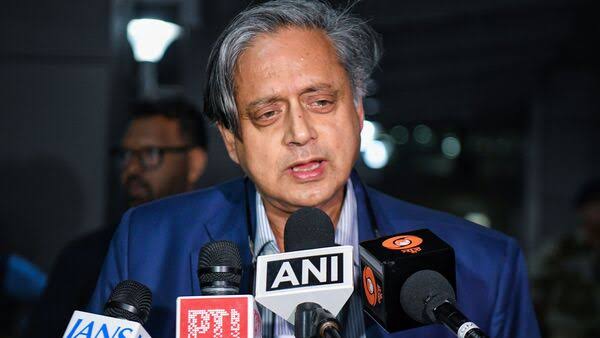
Indian politics is never short of drama, debate, and differing opinions — even within the same party. But amid all the noise, there are leaders who choose to respond with calm and clarity. Shashi Tharoor, a senior Congress leader known for his articulate style and composed attitude, did just that recently when some of his party colleagues made pointed remarks about him. Instead of reacting with anger or sarcasm, he responded with just a few calm words: “We’ll talk once we’re back.”
These words might sound simple, but they say a lot about Tharoor’s approach to politics, especially in a time when disagreements often lead to public spats. In the heat of an election season, when tempers tend to run high and everyone is trying to prove a point, Tharoor’s response stood out as mature and dignified.
The comments aimed at Tharoor came from a few Congress members who were reportedly unhappy with his independent tone and strong visibility in Kerala, where he has been actively campaigning. Some insiders felt that Tharoor was focusing more on his personal image than on the larger party narrative. Others believed that his popularity was making a few leaders uncomfortable. Whatever the reason, these under-the-surface tensions began to show through public statements, hinting at internal unease.
But instead of letting things spiral or turning the issue into a headline-grabbing feud, Tharoor kept his response grounded. Speaking to the media, he simply said, “When we get back, we can sit down and talk. Right now, we have a bigger task at hand.” That bigger task, of course, is the ongoing Lok Sabha elections — a time when party unity and focus should matter more than individual differences.
His words carried a clear message: personal egos and party politics can wait. The main priority now is to work together, connect with the public, and do what’s needed to earn the people’s trust.
Tharoor, who is contesting once again from the Thiruvananthapuram seat in Kerala, has always had a unique presence in Indian politics. He’s not the typical politician. With his background as a former UN diplomat, his global exposure, and his polished way of speaking, he has built a following that cuts across age groups, especially among the youth and urban voters.
He also brings a certain openness to his role. Over the years, he’s been vocal not just about national issues, but also about matters within the Congress party itself. He was one of the G-23 leaders — a group of senior Congress figures who wrote to the party high command seeking internal reforms and stronger leadership. While that move created ripples within the party, Tharoor continued to express his views in a respectful manner, never crossing the line into open rebellion.
This recent episode seems to follow a similar pattern. Some party leaders may see Tharoor’s rising popularity in Kerala as a challenge to the old guard. Others may feel he’s too outspoken for their liking. But instead of letting that become a messy power struggle, Tharoor has once again taken the high road — choosing silence, focus, and future discussion over immediate confrontation.
In a democracy, it’s natural for differences to exist — even within a single party. What matters is how those differences are handled. Do leaders use them to pull each other down? Or do they put aside their personal opinions to work for the greater goal? Tharoor, it seems, is choosing the second path.
In the world of politics, where quick soundbites often get more attention than quiet wisdom, Tharoor’s response didn’t make front-page headlines for being dramatic. But it did win him respect from many observers and ordinary citizens who are tired of the constant fighting and name-calling that often dominate political discourse.
Even on social media, where political tempers can run wild, many users praised his calm handling of the situation. “This is how mature politicians should speak,” one user commented. Another wrote, “You don’t have to shout to be strong. Tharoor just proved it again.”
It’s also worth noting that this isn’t the first time Shashi Tharoor has shown grace under pressure. Whether it’s dealing with criticism from opponents, handling online trolling, or facing internal party issues, he usually responds with poise. That style may not suit everyone, especially in a political climate where louder voices often get more attention. But for a large section of voters, that quiet strength is what sets him apart.
His choice of words — “We’ll talk once we’re back” — is more than just a way to brush off criticism. It’s also a reminder that there is a time and place for everything. Elections are not the moment for internal debates. The focus should be on the people — their needs, their hopes, and their future.
In recent weeks, Tharoor has been actively campaigning in Kerala, meeting with young voters, addressing local concerns, and highlighting the Congress party’s national vision. His speeches have focused on issues like employment, education, digital growth, and human rights — areas that matter to everyday citizens but often get lost in political fights.
His campaign also stands out for its modern, positive tone. Rather than attacking rivals aggressively, he often speaks about solutions, ideas, and the importance of respectful disagreement in a healthy democracy. This approach resonates with many voters who feel that politics should inspire hope, not fear or anger.
As the elections continue and results draw near, it remains to be seen how the Congress party will handle internal differences and what role Tharoor will play in shaping its future direction. For now, his decision to stay focused, not fuel the fire, and save the discussion for later shows that leadership is as much about timing as it is about words.
In the end, politics may be about winning seats and forming governments, but it’s also about character. How leaders act under pressure, how they deal with criticism, and how they choose unity over division — these are the qualities that leave a lasting impression.
Shashi Tharoor may not have shouted back, but his message was loud and clear: real strength doesn’t need noise.